H3C: mixed nozzles, local layer heights and a separate roadmap
Bambu H3C brings different layer heights to adjacent regions. What Bambu Studio 2.9.1 documents, and what remains an estimate for H2D, H2C and X2D.
Reading the launch at the boundary between regions
With H3C, announced on 3 November 2026, Bambu Lab highlights a specific capability: using different nozzle diameters and local layer heights within one model. For anyone considering the printer, the interesting point is the boundary between neighbouring areas needing different levels of detail. For H2D, H2C or X2D owners, the question is how much of this announcement already applies to their printer.
This is a documentary analysis of an FFF launch, current as of 13 November 2026. We distinguish H3C support described in a public release from estimated dates for other models. We have not performed slicing or printing tests, or verified the distributed binaries.
Diameter and height are different choices
The launch presents Swaptek as a nine-tool printing system. Tool changing is only part of the story: nozzle diameter influences extrusion width, while layer height concerns the vertical subdivision of the part. A different nozzle alone does not explain how two regions with different layer heights are coordinated.
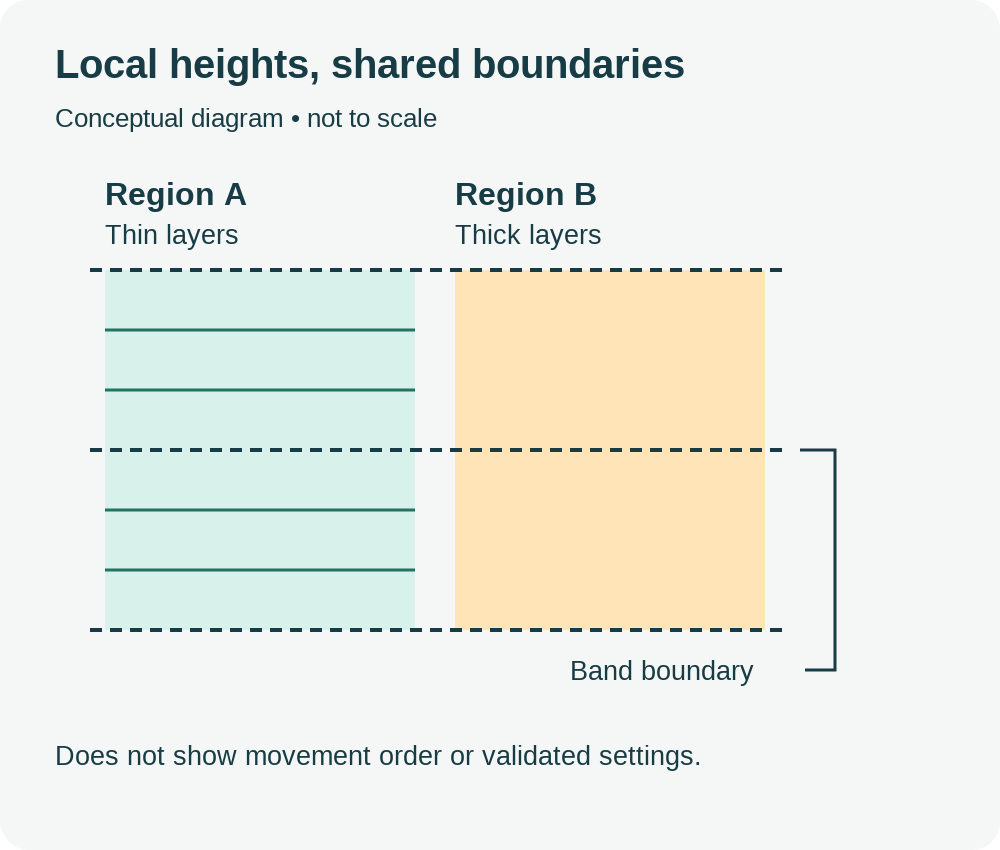
In its 9 November explanation, Bambu describes adjacent regions organised into bands: several thin layers in one region reach the height of one thick layer in the other. The regions synchronise at band boundaries. Our diagram simplifies that relationship; it does not show the complete movement sequence or a certified combination of settings.
The distinction from simply varying layer height along Z is local: the height does not necessarily change across the entire cross-section at a given elevation. This does not imply simultaneous deposition, non-planar printing or freedom to combine arbitrary heights. The official explanation includes planning and synchronisation, rather than removing geometric constraints.
What the public release documents
Bambu Studio 2.9.1 Public Release, tag v02.09.01.70, describes Mixed Nozzle Diameter Slicing and Printing. Its notes distinguish assignment to walls, infill or supports from assignment to regions of the same model, with different heights within the same Z interval. The initial support specified is H3C; other models depend on subsequent announcements.
This is stronger documentary evidence than a future promise alone, but it is not our own test of the feature. Focusing detail where it is needed is a plausible design interest: these sources do not establish measured time savings, guaranteed quality or a complete compatibility matrix of materials and nozzle diameters.
For H2D, H2C and X2D, dates remain estimates
The official 3 November roadmap separates configurations with and without Filament Track Switch. The switch concerns filament routing: it is not the Swaptek tool changer and does not create local layer heights by itself. The stated windows are:
- H2D without Filament Track Switch: November 2026; the official forum post specifies late November. With the switch: February 2027.
- H2C without the switch: February 2027. With the switch: March 2027.
- X2D without the switch: February 2027. With the switch: March 2027.
- All these dates are development estimates, not confirmations of availability.
Different implications for buyers and existing owners
The forum’s “late November” wording makes the month in the blog more precise; it does not establish a delay. As of 13 November, the sources opened for this analysis did not provide a release confirming activation on H2D, H2C or X2D. H3C support therefore cannot automatically be transferred to an existing printer.
For anyone considering H3C, the distinctive feature to investigate is detail management across adjacent regions. For owners of other models, the roadmap is something to follow, rather than a basis for guaranteed compatibility today. The term “multi-orifice” in the roadmap title should not be treated as evidence of one nozzle with multiple holes: the documented topic is combining different diameters.
Questions that remain open
The listed sources are manufacturer communications and documentation accessed on 13 November 2026. The linked technical wiki pages for H3C and Filament Track Switch were inaccessible during verification: we cannot certify exact layer-height formulas, every permitted combination or the complete restrictions.
We have not verified prices, commercial availability, shipping or practical reliability. No image here is a test print or a slicer preview. The useful distinction in this launch remains: H3C has support documented in public release notes; extension to other models has estimated dates and needs model-specific release confirmation.
Sources
- Bambu Lab presents H3C — announcement, 3 November 2026 — Bambu Lab, accessed on November 13, 2026
- The Impossible Slice — local layer heights, 9 November 2026 — Bambu Lab, accessed on November 13, 2026
- Bambu Studio 2.9.1 Public Release — v02.09.01.70 — Bambu Lab, accessed on November 13, 2026
- H2D, H2C and X2D — estimated mixed-nozzle roadmap, 3 November 2026 — Bambu Lab, accessed on November 13, 2026
- BambuLab official forum announcement — mixed nozzle roadmap, 3 November 2026 — Bambu Lab, accessed on November 13, 2026