OpenPrintTag: an open format with specific compatibility conditions
Spool data, Prusa automations and reader constraints: why an open standard does not make filament recognition universal.
A shared language does not make every printer communicate
A spool can store material, colour and remaining quantity without every printer being able to use them. This is the key distinction with OpenPrintTag: an open format makes the data rules public; recognition and automation also depend on the reader, firmware and machine configuration.
For FDM/FFF users, particularly CORE One owners, this distinction matters more than a “smart” label. We analyse official documentation and statements accessed on 15 November 2026, without our own reading, interoperability or printing tests. The subject is spool integration within an ecosystem, rather than an installation procedure.
What the open format provides
The official specification repository is distributed under the MIT license. The NFC format documents NFC-V (ISO/IEC 15693-3), NDEF and CBOR-encoded data. These are shared rules for representing spool information, rather than a list of printers that can read it.
Essential data resides on the tag, and the OpenPrintTag website describes local recognition without Wi-Fi or cloud. That benefit concerns data stored on the spool; any linked web resources still require access to those resources. A field defined by the specification also does not prove that every reader uses it: the schema includes, for example, material type, colour and preheat temperature.
“Rewritable” needs a distinction too. Prusa describes tags on new Prusament spools as fully rewritable, but the format allows the main static-data section to be locked and separates an optional auxiliary section for dynamic data. A Prusament tag’s rewritability cannot be extended to every field in every implementation.
Declared automations are not material measurements
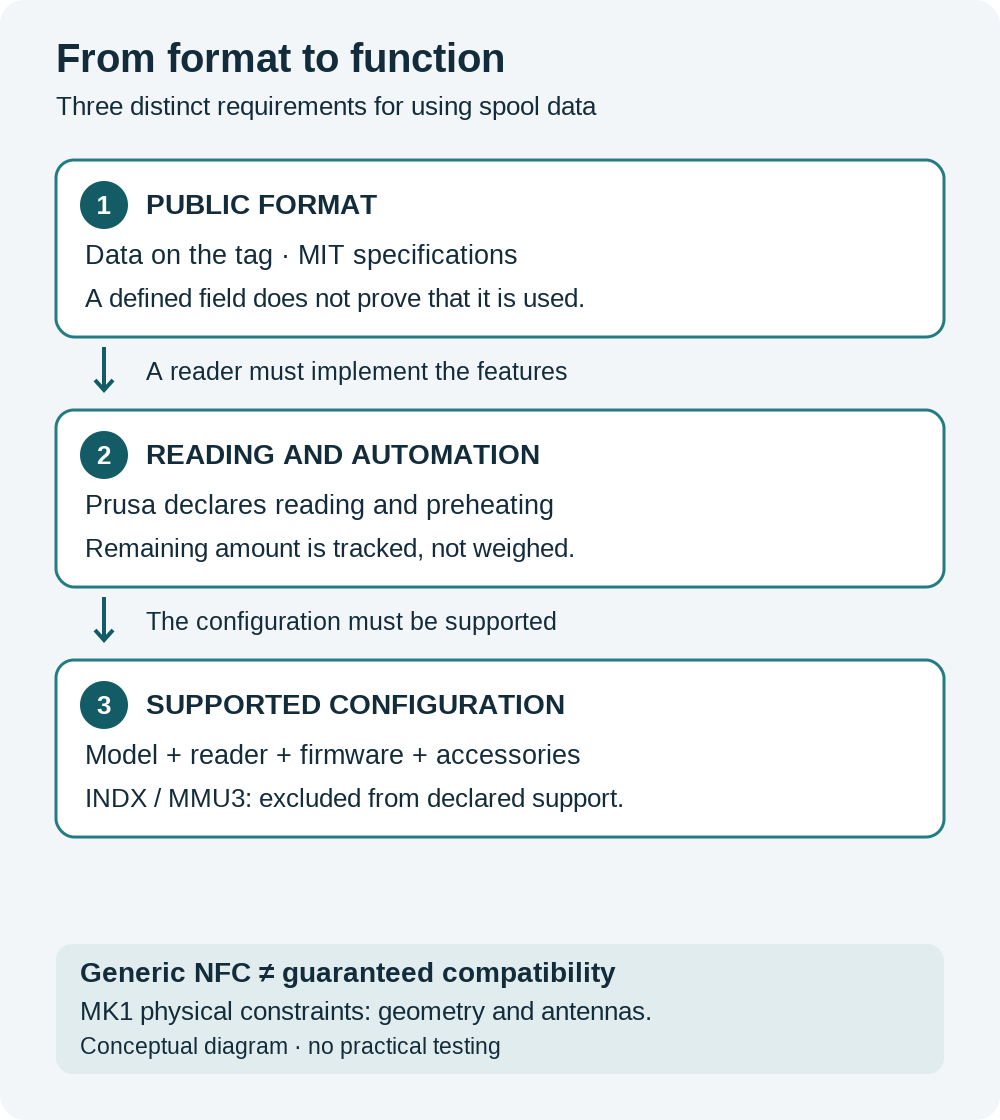
The Prusa upgrade listing declares material and colour reading, preheating and remaining-quantity updates. The material being read is the one recorded on the tag: the reader is not physically analysing the polymer. Likewise, the remaining amount comes from tracked consumption, rather than directly weighing the spool.
Buddy firmware 8.0.0 notes describe writes after loading, before unloading, at the end of a print and during printing with a minimum interval of five minutes. The value should therefore not be interpreted as a continuous measurement or a guarantee of accuracy. The notes also mention remaining weight and length, and a warning when the recorded material is insufficient for the G-code.
Automation has boundaries too: for M600 and the Load/Change buttons in the preview, the notes specify use of the filament defined by the G-code. Having a tag does not mean that every job setting is automatically replaced with spool data.
Compatibility concerns a specific configuration
The upgrade listing names CORE One, CORE One+, CORE One+ (Gen 2), CORE One L and CORE One L+, with Prusa Drybox support. The Knowledge Base requires firmware 8.0.0 or newer and excludes the Prusa Orange spoolholder. This is the scope declared by the sources we accessed, rather than our own certification of those combinations.
INDX and MMU3 are currently excluded by the listing. The 8.0.0 notes clarify that enabling MMU disables reading and disconnects the tag from the loaded filament. The general printer list in the release title does not extend this feature to every model: the relevant entries are marked C1/C1L.
The Knowledge Base identifies a preinstalled cable in assembled CORE One+ (Gen 2) and CORE One L+ versions. A preinstalled cable does not establish that the reader is included. Evaluating the integration means considering model, accessories and reader together.
Why a generic NFC tag is not enough
The technical details describe a design conceived for ICODE SLIX2 and intended for NFC-V compatibility. However, the current physical specification identifies only the OpenPrintTag MK1 reference as supported and sets constraints on geometry, placement and antenna coupling. A sticker simply labelled NFC, or the 13.56 MHz frequency alone, does not establish that it works with this reader.
The gap between openness and interoperability is concrete here: public specifications allow others to design integrations, but do not show that every available tag or device has already implemented them. We have not tested alternative tags or inferred universal compatibility with other filament-management systems from these sources.
A 2025 announcement, a documentary assessment today
The dedicated OpenPrintTag announcement was published on 31 October 2025. Its forecast of readers for “most Prusa 3D printers” in the first quarter of 2026 belongs to that roadmap; it does not establish delivery during that period. The sources accessed do not establish an unambiguous primary date for the reader’s commercial launch; this article does not present it as a newly released product.
For anyone evaluating spool management, openness offers a documented basis for sharing data; useful automations remain tied to the implementation. Before relying on recognition, compare your own configuration with the declared support, distinguishing reader presence, required firmware and excluded accessories.
We have not verified prices, availability, remaining-quantity accuracy or practical reliability. The specification website returned a loading screen during verification: the technical details discussed here come from readable source documents in the official repository, listed below.
Sources
- OpenPrintTag — original announcement of 31 October 2025 — Prusa Research, accessed on November 15, 2026
- OpenPrintTag upgrade — declared features and compatibility — Prusa Research, accessed on November 15, 2026
- OpenPrintTag — local data and offline recognition — OpenPrintTag, accessed on November 15, 2026
- OpenPrintTag upgrade — requirements and operation — Prusa Research, accessed on November 15, 2026
- Buddy firmware 8.0.0 — OpenPrintTag notes — Prusa Research, accessed on November 15, 2026
- OpenPrintTag specification — MIT license — OpenPrintTag, accessed on November 15, 2026
- OpenPrintTag specification — NFC data format — OpenPrintTag, accessed on November 15, 2026
- OpenPrintTag specification — main data fields — OpenPrintTag, accessed on November 15, 2026
- OpenPrintTag specification — NFC technical details — OpenPrintTag, accessed on November 15, 2026
- OpenPrintTag specification — physical constraints and MK1 reference — OpenPrintTag, accessed on November 15, 2026